ShardTensor
Domain parallelism for high-resolution science
Corey Adams, Peter Harrington, Akshay Subramaniam, Mohammad Shoaib Abbas, Jaideep Pathak, Negin Sobhani, Dallas Foster, Mike Pritchard, Sanjay Choudhry
NVIDIA · AI4S Workshop @ SC26, Chicago
NVIDIA · AI4S Workshop @ SC26, Chicago
AI for Science is working
Proteins Structure prediction competitive with experiment AlphaFold · Nature 2021
Weather Global medium-range forecasts that beat operational numerical systems GraphCast · Science 2023; Pangu-Weather · Nature 2023
Fusion Magnetic control of tokamak plasmas by deep reinforcement learning Nature 2022
Materials Deep learning at scale for materials discovery, and autonomous synthesis labs Nature 2023 (×2)
Fluids Machine-learning-accelerated computational fluid dynamics PNAS 2021
Medicine Dermatologist-level classification of skin cancer Nature 2017
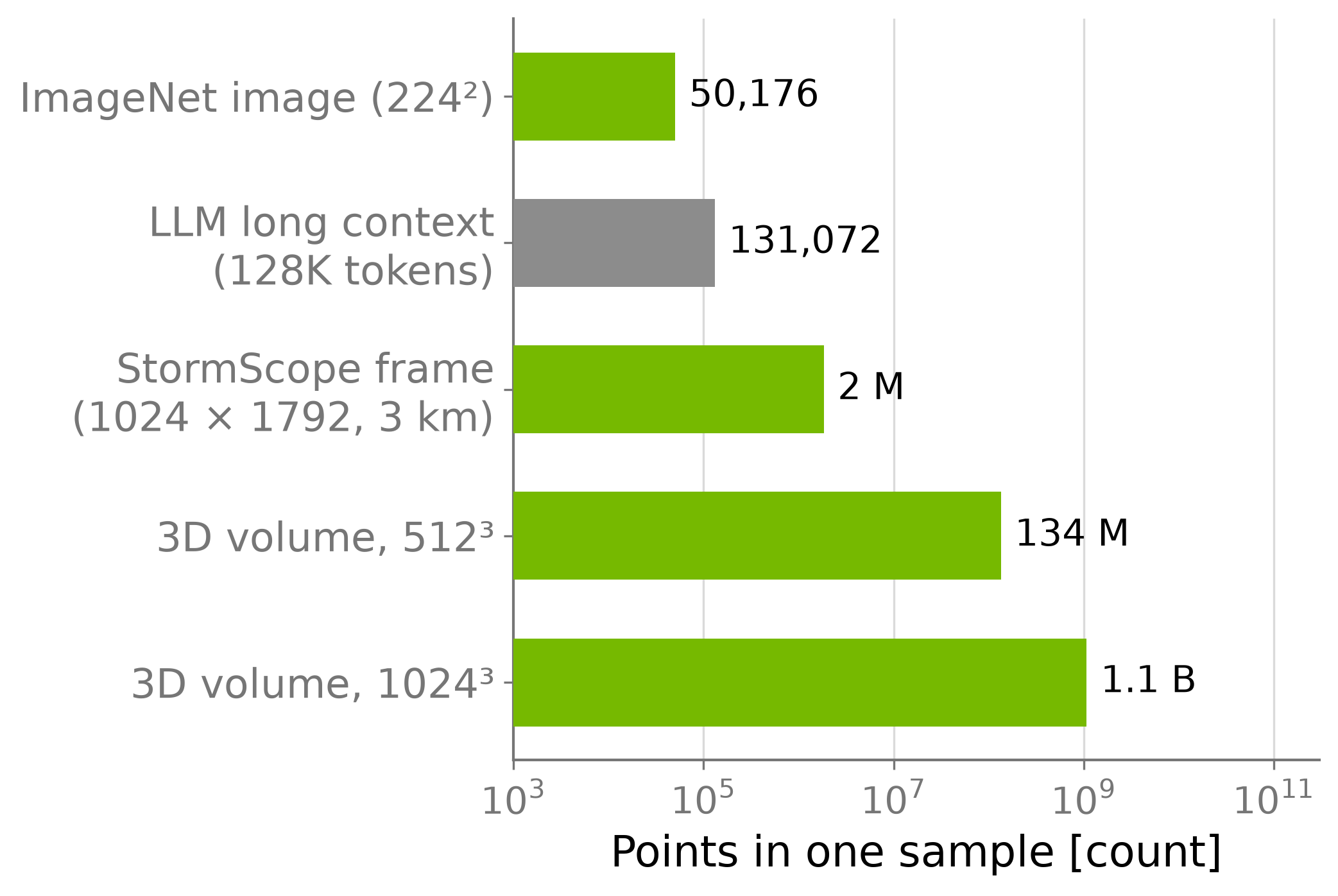
Science wants resolution
Resolution is where discoveries are made:
- the first image of a black hole
- atomic-resolution protein structures from cryo-EM
- a petavoxel map of human cortex
- meter-scale clouds that drive climate sensitivity
one scientific sample is often far larger than one language-model sample.
But, training an AI for Science model at true resolution is hard
torch.cuda.OutOfMemoryError: CUDA out of memory.
Current parallelism was built for different problems
The parallelism toolbox came from image and language models
| Method | What it splits | Built for |
|---|---|---|
| Data parallel (Horovod, DDP) | the batch: one or more samples per GPU | more data per step |
| Fully sharded (FSDP, ZeRO) | weights, gradients, optimizer state | models too big for one GPU |
| Tensor parallel | each weight matrix | layers too big for one GPU |
| Pipeline parallel | groups of layers | very deep models |
| Context / sequence parallel | tokens, inside attention | long text; transformers only |
Every tool assumes either that one sample fits on a GPU, or that the model is a transformer.
Why does resolution become memory?
\( z = W x + b \)
→
→
\(W\)
\(W:\; N \times N\)
\(x:\; P \times N\)
\(z:\; P \times N\)
one H100: 80 GB
weights: 1 MB
Variable
Source
Floats (fp32 = 4 B)
When
\( x, z \)
Active data
\( P \times N \)
Train & infer
\( W, b \)
Model weights
\( N^2 \)
Train & infer
\( \nabla W, m, v \)
Training buffers
\( 3 \times N^2 \)
Train only
\( \text{saved } x \)
Saved activations
\( P \times N \)
Train only
Why does resolution become memory?
\( z = W x + b \)
→
→
\(W\)
\(W:\; N \times N\)
\(x:\; P \times N\)
\(z:\; P \times N\)
one H100: 80 GB
weights: 1 MB
Variable
Source
Floats (fp32 = 4 B)
When
\( x, z \)
Active data
\( P \times N \)
Train & infer
\( W, b \)
Model weights
\( N^2 \)
Train & infer
\( \nabla W, m, v \)
Training buffers
\( 3 \times N^2 \)
Train only
\( \text{saved } x \)
Saved activations
\( P \times N \)
Train only
Why does resolution become memory?
\( z = W x + b \)
→
→
\(W\)
\(W:\; N \times N\) (+ buffers)
\(\nabla W\)
\(m, v\)
\(m, v\)
\(x:\; P \times N\)
\(z:\; P \times N\)
one H100: 80 GB
weights + buffers: 4 MB
Variable
Source
Floats (fp32 = 4 B)
When
\( x, z \)
Active data
\( P \times N \)
Train & infer
\( W, b \)
Model weights
\( N^2 \)
Train & infer
\( \nabla W, m, v \)
Training buffers
\( 3 \times N^2 \)
Train only
\( \text{saved } x \)
Saved activations
\( P \times N \)
Train only
Why does resolution become memory?
\( z = W x + b \qquad\Rightarrow\qquad \tfrac{\partial L}{\partial W} = (\tfrac{\partial L}{\partial z})^{\!\top} x \)
→
→
\(W\)
\(W:\; N \times N\) (+ buffers)
\(\nabla W\)
\(m, v\)
\(m, v\)
\(x:\; P \times N\)
\(z:\; P \times N\)
saved for backward
one H100: 80 GB
weights + buffers: 4 MB
Variable
Source
Floats (fp32 = 4 B)
When
\( x, z \)
Active data
\( P \times N \)
Train & infer
\( W, b \)
Model weights
\( N^2 \)
Train & infer
\( \nabla W, m, v \)
Training buffers
\( 3 \times N^2 \)
Train only
\( \text{saved } x \)
Saved activations
\( P \times N \)
Train only
Why does resolution become memory?
\( z = W x + b \qquad\Rightarrow\qquad \tfrac{\partial L}{\partial W} = (\tfrac{\partial L}{\partial z})^{\!\top} x \)
→
→
\(W\)
\(W:\; N \times N\) (+ buffers)
\(\nabla W\)
\(m, v\)
\(m, v\)
\(x:\; 64^3 \times 512\)
\(z:\; 64^3 \times 512\)
saved for backward
one H100: 80 GB
537 MB
weights + buffers: 4 MB
Variable
Source
Floats (fp32 = 4 B)
Total
When
\( x, z \)
Active data
\( 64^3 \times 512 \)
537 MB
Train & infer
\( W, b \)
Model weights
\( 512^2 \)
1 MB
Train & infer
\( \nabla W, m, v \)
Training buffers
\( 3 \times 512^2 \)
3 MB
Train only
\( \text{saved } x \)
Saved activations
\( 64^3 \times 512 \)
537 MB
Train only
Why does resolution become memory?
\( z = W x + b \qquad\Rightarrow\qquad \tfrac{\partial L}{\partial W} = (\tfrac{\partial L}{\partial z})^{\!\top} x \)
→
→
\(W\)
\(W:\; N \times N\) (+ buffers)
\(\nabla W\)
\(m, v\)
\(m, v\)
\(x:\; 128^3 \times 512\)
\(z:\; 128^3 \times 512\)
saved for backward
one H100: 80 GB
4 GB
weights + buffers: 4 MB
Variable
Source
Floats (fp32 = 4 B)
Total
When
\( x, z \)
Active data
\( 128^3 \times 512 \)
4 GB
Train & infer
\( W, b \)
Model weights
\( 512^2 \)
1 MB
Train & infer
\( \nabla W, m, v \)
Training buffers
\( 3 \times 512^2 \)
3 MB
Train only
\( \text{saved } x \)
Saved activations
\( 128^3 \times 512 \)
4 GB
Train only
Why does resolution become memory?
\( \text{fp32 (4 B/val):} \quad 4\,\text{B} \times L \times (\; \underbrace{4N^2}_{W \text{ + buffers}} \;+\; \underbrace{P N}_{\text{saved } x} \;) \)
\(W_{1}\)
\(W_{2}\)
\(W_{3}\)
\(W_{4}\)
\(W_{5}\)
\(W_{6}\)
\(W_{7}\)
\(W_{8}\)
\(W_{9}\)
\(W_{10}\)
\(W_{11}\)
\(W_{12}\)
\(W_{13}\)
\(W_{14}\)
\(W_{15}\)
\(W_{16}\)
\(W_{17}\)
\(W_{18}\)
\(W_{19}\)
\(W_{20}\)
one H100: 80 GB
86 GB
weights + buffers: 84 MB
Variable
Source
Floats (fp32 = 4 B)
Total
When
\( x, z \)
Active data
\( 128^3 \times 512 \)
4 GB
Train & infer
\( W, b \)
Model weights
\( 20 \times 512^2 \)
21 MB
Train & infer
\( \nabla W, m, v \)
Training buffers
\( 3 \times 20 \times 512^2 \)
63 MB
Train only
\( x_1 \dots x_L \)
Saved activations
\( 20 \times 128^3 \times 512 \)
86 GB
Train only
On one GPU, every fix has a cost
as is
86 GB
fp32, 20 layers
half precision
43 GB
only 2×, once;
less dynamic range
less dynamic range
half the layers
43 GB
a smaller,
less accurate model
less accurate model
checkpoint:
save 1 layer in 4
save 1 layer in 4
21 GB
recompute the rest
in backward: slower
in backward: slower
downsample
to 64³
to 64³
11 GB
loses the
fine detail
fine detail
Every single-GPU fix trades away speed, model size, or resolution.
Four GPUs: what can we split?
Shard the weights (FSDP, tensor parallel)
one sample: 128³ points
GPU 0
86 GB
GPU 1
¼ of W: 5 MB
GPU 2
¼ of W: 5 MB
GPU 3
¼ of W: 5 MB
The weights were only 21 MB. The saved inputs still sit on one GPU.
Four GPUs: what can we split?
Split the batch (data parallel, DDP)
one sample: 128³ points
GPU 0
86 GB
GPU 1
idle
GPU 2
idle
GPU 3
idle
Each GPU needs a whole sample. At batch size 1, there is nothing left to split.
Four GPUs: what can we split?
Split the sample (domain parallel)
one sample: 128³ points
GPU 0
21 GB
GPU 1
21 GB
GPU 2
21 GB
GPU 3
21 GB
Each GPU holds a quarter of the points, and a full copy of the small weights.
Domain parallelism today: proven, but bespoke
| Where | What it splits | The catch |
|---|---|---|
| Classical HPC: CFD, climate, molecular dynamics | the simulation domain, for decades | solvers, not ML models |
| Ring Attention, DeepSpeed Ulysses | the token sequence | attention and transformers only |
| Makani (weather), Transolver++ (CFD) | the spatial domain | written into one model |
| DistDL | layers, over MPI | rebuild the model; fixed partitions |
PyTorch DTensor |
any tensor | built for weights: even, static shapes |
JAX shard_map |
anything | you compose every operation by hand |
Missing: a general tool where your model runs unchanged.
ShardTensor
What is ShardTensor?
One logical tensor, uneven pieces across GPUs
GPU 0
local shard
34k pts
GPU 1
local shard
28k pts
GPU 2
local shard
36k pts
GPU 3
local shard
24k pts
Why it matters:
• Your model stays a 1-GPU model — no parallel code in
forward()• Each GPU's piece can have a different size (convolutions, meshes, point clouds)
• Exact single-GPU math — halos, all-reduces, and rings run automatically
• Composes with DDP & FSDP2 for data × domain (× model)
Extends PyTorch's
DTensor for scientific dataPyTorch DTensor
ShardTensor
Built for
Model weights
High-res inputs & activations
Chunk sizes
Even only (
torch.chunk)Uneven per GPU (tracks per-rank shapes)
Shapes
Static across steps
Dynamic through layers
Operations
Generic tensor redistributions
Halo, ring, all-reduce +
DTensor fallbackModel code
distribute_moduleUnchanged
nn.ModuleWhat DDP did for data parallelism, ShardTensor does for domain parallelism — open source in
physicsnemo.domain_parallel.In practice: two lines change
from torch.distributed.device_mesh import init_device_mesh
from torch.nn.parallel import DistributedDataParallel as DDP
from torch.distributed.tensor import Shard
from physicsnemo.domain_parallel import scatter_tensor, sync_module_over_mesh

mesh = init_device_mesh("cuda", (16, 2), mesh_dim_names=("data", "domain"))
model = MyModel().cuda()  # your model, unchanged
model = DDP(model, process_group=mesh["data"].get_group())
loss_fn(model(x), y).backward()
MyModel is not rewritten. The ShardTensor input triggers domain-parallel dispatch inside every layer, forward and backward.
In practice: two lines change
from torch.distributed.device_mesh import init_device_mesh
from torch.nn.parallel import DistributedDataParallel as DDP
from torch.distributed.tensor import Shard
from physicsnemo.domain_parallel import scatter_tensor, sync_module_over_mesh

mesh = init_device_mesh("cuda", (16, 2), mesh_dim_names=("data", "domain"))
model = MyModel().cuda()  # your model, unchanged
# 1. Make the weights agree across GPUs that share a sample
sync_module_over_mesh(model, mesh["domain"])
model = DDP(model, process_group=mesh["data"].get_group())
# 2. Split each input sample along its height axis
x = scatter_tensor(x, src, mesh["domain"], (Shard(2),))
loss_fn(model(x), y).backward()
MyModel is not rewritten. The ShardTensor input triggers domain-parallel dispatch inside every layer, forward and backward.
Under the hood: dispatch, layer by layer
Your model, written for one GPU
Conv
Norm
→
MLP
→
Attention
→
MLP
→
Loss
→
Under the hood: dispatch, layer by layer
Each operation is dispatched as it runs
Conv
Norm
→
MLP
→
Attention
→
MLP
→
Loss
→
halo
all-reduce
local
ring
local
all-reduce
Under the hood: dispatch, layer by layer
…and routed across the GPUs that share the sample
Conv
Norm
→
MLP
→
Attention
→
MLP
→
Loss
→
halo
all-reduce
local
ring
local
all-reduce
GPU 0
GPU 1
GPU 2
GPU 3
↕
↕
↕
↕
↕
↕
Linear layers, MLPs, and activations
GPU 0
GPU 1
GPU 2
GPU 3
W
W
W
W
z = Wx + b ✓
z = Wx + b ✓
z = Wx + b ✓
z = Wx + b ✓
Each point is updated from its own features alone.
Each GPU runs the layer on its own piece.
Each GPU runs the layer on its own piece.
No communication between GPUs. Only layers that mix points need to talk.
Convolutions and local stencils
A convolution updates each cell from its local neighborhood (e.g. 3 × 3).
Convolutions and local stencils
GPU 0
GPU 1
?
?
?
At a GPU boundary, part of the neighborhood sits on the adjacent GPU.
Convolutions and local stencils
GPU 0
GPU 1
Halo exchange: each GPU copies a thin boundary strip from its neighbor.
Normalization, pooling, and losses
GPU 0
GPU 1
GPU 2
GPU 3
Σx, Σx² on 0
Σx, Σx² on 1
Σx, Σx² on 2
Σx, Σx² on 3
Normalization and loss layers need statistics over the whole sample. Each GPU sums its local shard.
Normalization, pooling, and losses
GPU 0
GPU 1
GPU 2
GPU 3
Σx, Σx² on 0
Σx, Σx² on 1
Σx, Σx² on 2
Σx, Σx² on 3
mean, var
mean, var
mean, var
mean, var
mean, var
All-reduce: combine the partial sums across GPUs…
Normalization, pooling, and losses
GPU 0
GPU 1
GPU 2
GPU 3
mean, var
mean, var
mean, var
mean, var
mean, var
…so every GPU gets the exact global statistics. Only a few scalars move.
Self-attention and global layers
GPU 0
Q0
GPU 1
Q1
GPU 2
Q2
GPU 3
Q3
K0 V0
K1 V1
K2 V2
K3 V3
Q0
K0
Q1
K1
Q2
K2
Q3
K3
one GPU
Self-attention mixes every point with every other point (all pairs of Q and K, V).
H. Liu, M. Zaharia, P. Abbeel, “Ring Attention with Blockwise Transformers for Near-Infinite Context,” arXiv:2310.01889 (2023)
Self-attention and global layers
GPU 0
Q0
GPU 1
Q1
GPU 2
Q2
GPU 3
Q3
K0 V0
K1 V1
K2 V2
K3 V3
Q0
K0
Q1
K1
Q2
K2
Q3
K3
one GPU
Ring attention: each GPU keeps its own queries Qi and starts with its local Ki, Vi.
H. Liu, M. Zaharia, P. Abbeel, “Ring Attention with Blockwise Transformers for Near-Infinite Context,” arXiv:2310.01889 (2023)
Self-attention and global layers
GPU 0
Q0
GPU 1
Q1
GPU 2
Q2
GPU 3
Q3
K0 V0
K1 V1
K2 V2
K3 V3
Q0
K0
Q1
K1
Q2
K2
Q3
K3
one GPU
Ring attention (step 1/4): compute attention block while passing K, V to the next GPU.
H. Liu, M. Zaharia, P. Abbeel, “Ring Attention with Blockwise Transformers for Near-Infinite Context,” arXiv:2310.01889 (2023)
Self-attention and global layers
GPU 0
Q0
GPU 1
Q1
GPU 2
Q2
GPU 3
Q3
K0 V0
K1 V1
K2 V2
K3 V3
Q0
K0
Q1
K1
Q2
K2
Q3
K3
one GPU
Ring attention (step 2/4): compute attention block while passing K, V to the next GPU.
H. Liu, M. Zaharia, P. Abbeel, “Ring Attention with Blockwise Transformers for Near-Infinite Context,” arXiv:2310.01889 (2023)
Self-attention and global layers
GPU 0
Q0
GPU 1
Q1
GPU 2
Q2
GPU 3
Q3
K0 V0
K1 V1
K2 V2
K3 V3
Q0
K0
Q1
K1
Q2
K2
Q3
K3
one GPU
Ring attention (step 3/4): compute attention block while passing K, V to the next GPU.
H. Liu, M. Zaharia, P. Abbeel, “Ring Attention with Blockwise Transformers for Near-Infinite Context,” arXiv:2310.01889 (2023)
Self-attention and global layers
GPU 0
Q0
GPU 1
Q1
GPU 2
Q2
GPU 3
Q3
K0 V0
K1 V1
K2 V2
K3 V3
Q0
K0
Q1
K1
Q2
K2
Q3
K3
one GPU
Ring attention (step 4/4): compute attention block while passing K, V to the next GPU.
H. Liu, M. Zaharia, P. Abbeel, “Ring Attention with Blockwise Transformers for Near-Infinite Context,” arXiv:2310.01889 (2023)
Self-attention and global layers
GPU 0
Q0
GPU 1
Q1
GPU 2
Q2
GPU 3
Q3
K0 V0
K1 V1
K2 V2
K3 V3
Q0
K0
Q1
K1
Q2
K2
Q3
K3
Ring attention: after 4 steps, every GPU has attended to the full sample.
H. Liu, M. Zaharia, P. Abbeel, “Ring Attention with Blockwise Transformers for Near-Infinite Context,” arXiv:2310.01889 (2023)
Three patterns cover most scientific models
| Layers | Communication | What moves |
|---|---|---|
| Linear, MLP, activations | none | nothing |
| Convolution, neighborhood attention, graph message passing | halo exchange | a thin edge from each neighbor |
| Normalization, pooling, loss | all-reduce | a few statistics per GPU |
| Full attention | ring | keys and values, overlapped with compute |
Each gives the same answer as one GPU.
Extending ShardTensor: your own operation
import torch, torch.distributed as dist
from torch.distributed.tensor import Replicate
from physicsnemo.domain_parallel import ShardTensor

def sharded_dot(func, types, args, kwargs):
    x, y = args
    out = torch.dot(x.to_local(), y.to_local())  # each GPU: its own piece
    dist.all_reduce(out, group=x._spec.mesh.get_group())  # sum over GPUs
    return ShardTensor.from_local(out, x._spec.mesh, (Replicate(),))
ShardTensor.register_function_handler(torch.dot, sharded_dot)
Register handlers for Python functions, torch.library.custom_op kernels, or low-level aten ops — intercept and parallelize user code at whatever level fits your model.
Two axes of parallelism: data × domain
Data parallel: one sample per GPU
data axis (DDP or FSDP2): one sample per group →
… ×16
GPU 0
GPU 1
GPU 2
GPU 3
DDP and FSDP2 scale across samples. Each GPU must still hold a whole sample.
Two axes of parallelism: data × domain
Data × domain:
init_device_mesh("cuda", (16, 2))data axis (DDP or FSDP2): one sample per group →
… ×16
domain axis
(ShardTensor):
one sample,
2 GPUs ↓
(ShardTensor):
one sample,
2 GPUs ↓
GPU 0
GPU 1
↕
GPU 2
GPU 3
↕
GPU 4
GPU 5
↕
GPU 6
GPU 7
↕
ShardTensor splits each group's sample across a second axis. With FSDP2 the weights are sharded too: data × domain × model.
Does it scale?
A vision transformer on a billion-voxel volume
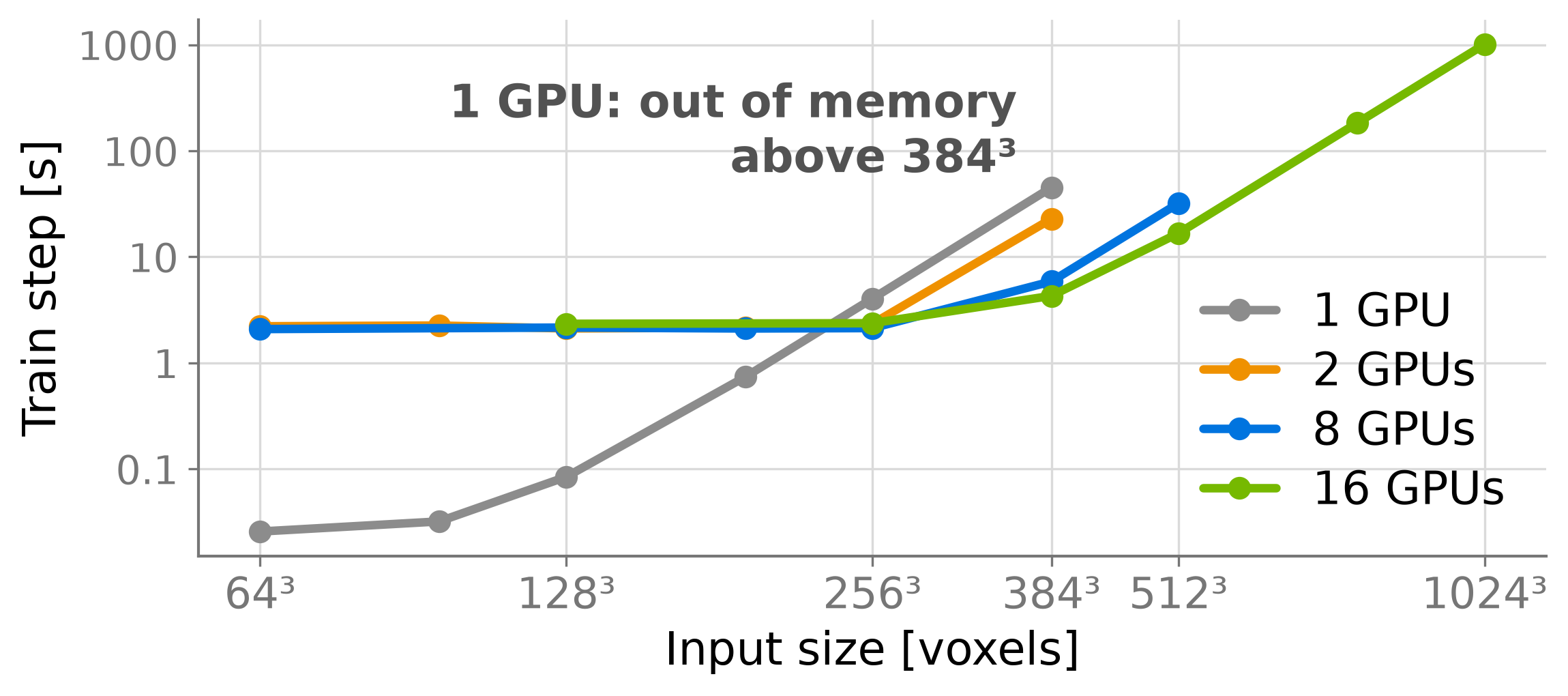
One GPU stops at 384³. 16 GPUs train 1024³ = 1.07 billion points, and run 384³ 10.5× faster.
Large problems scale nearly linearly
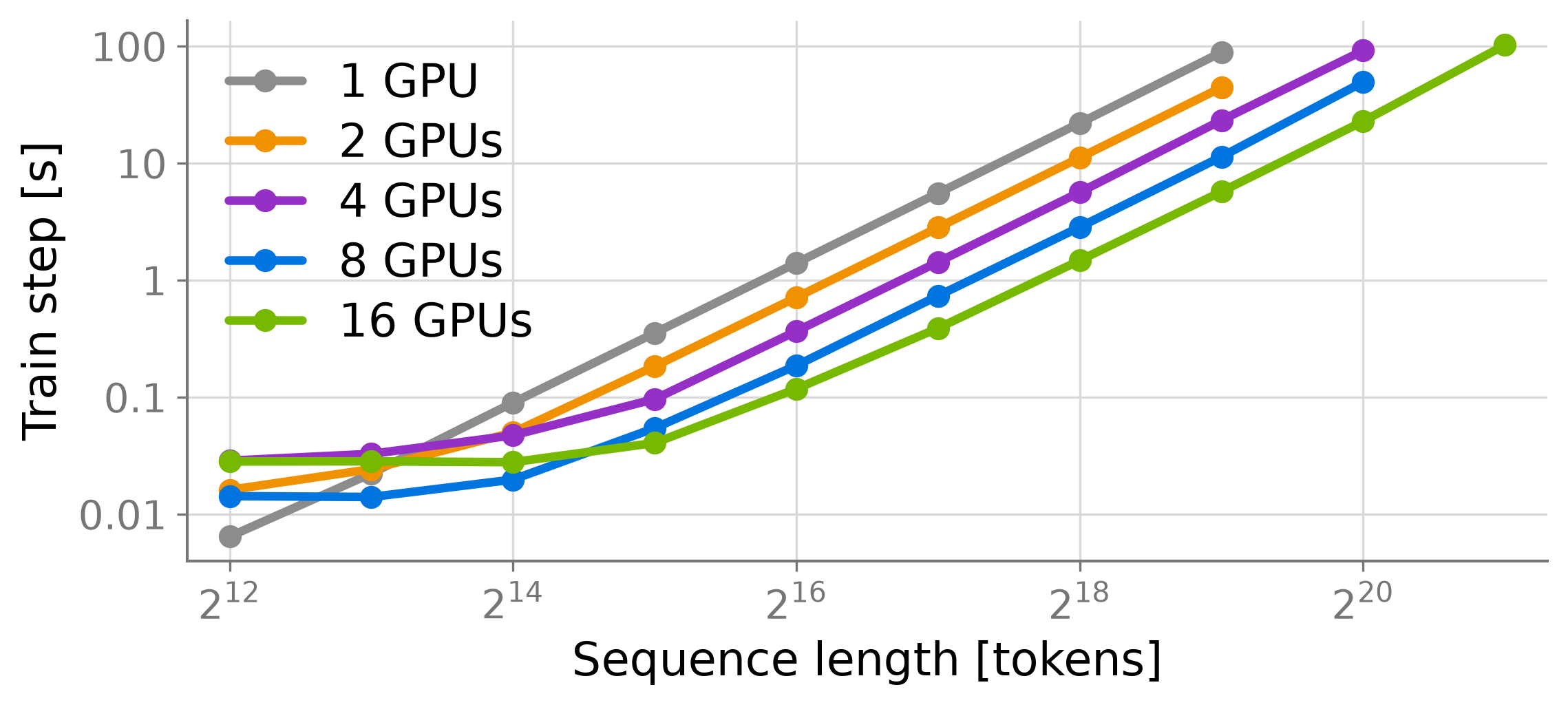
Ring attention training latency. At 2¹⁹ tokens, 16 GPUs are 97% efficient (96% for inference).
Inference at high resolution is faster too
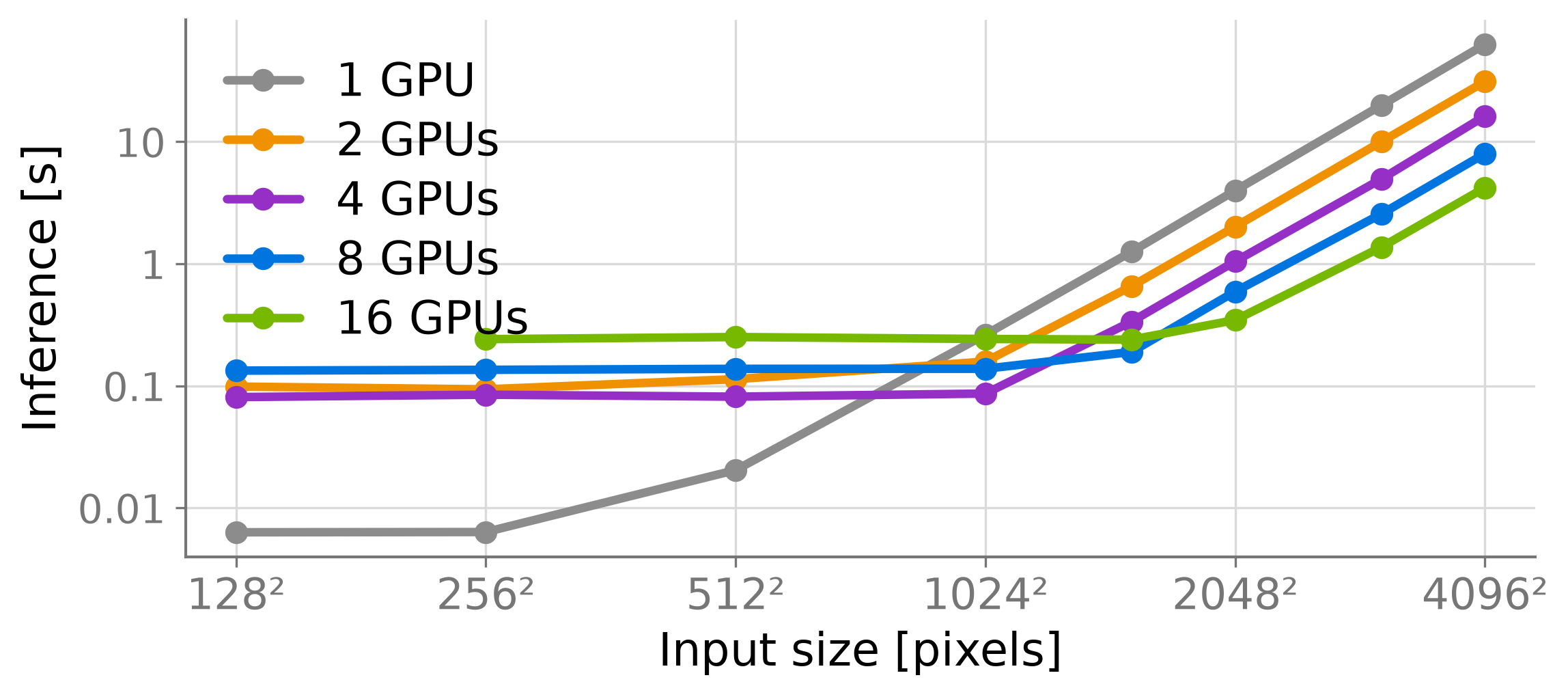
ViT inference on 2D data: 16 GPUs are 14.9× faster than one at 4096².
Dispatch overhead is small; torch.compile cuts it
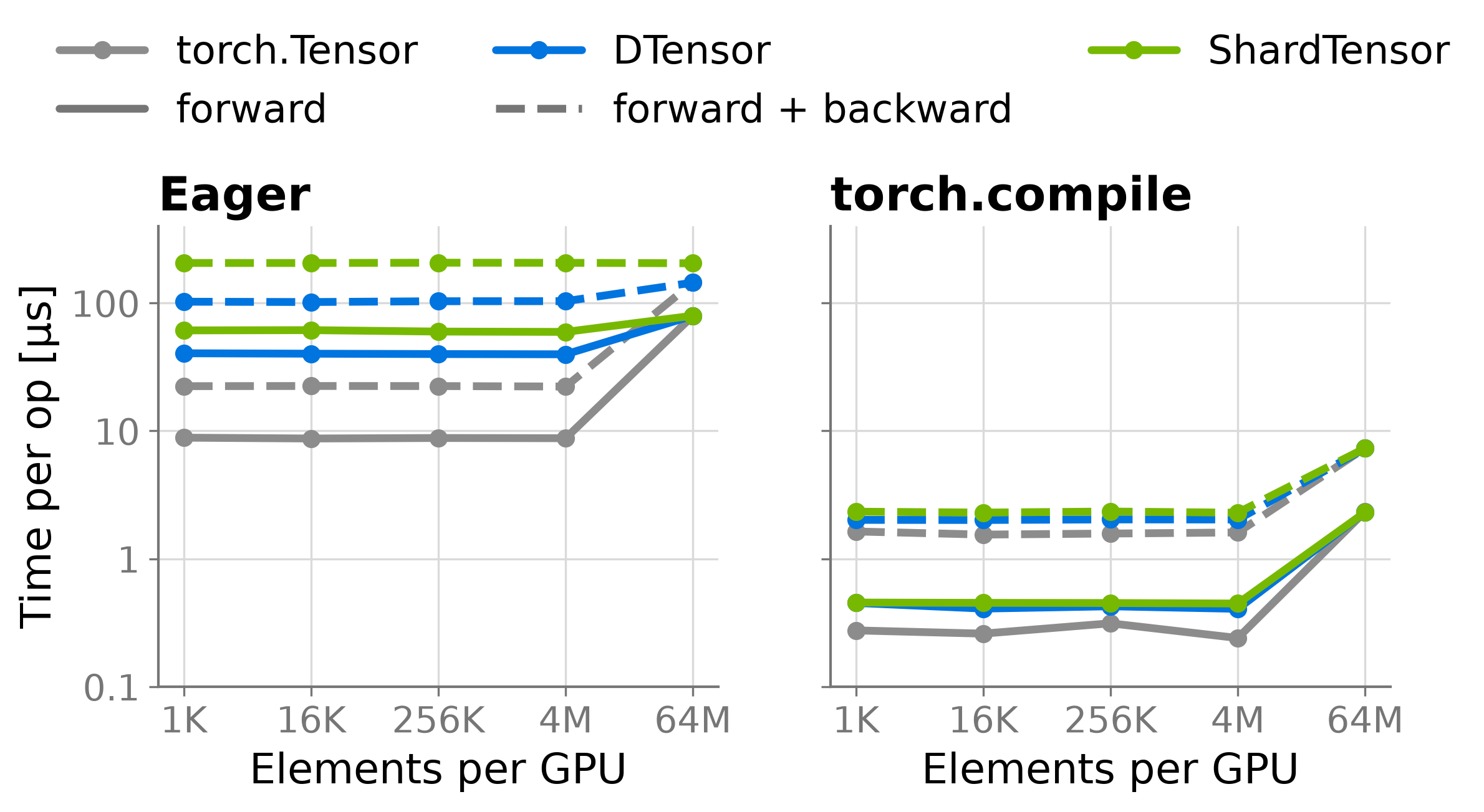
At scientific resolutions, ~60 µs of eager dispatch is small next to GPU kernel time. torch.compile cuts it 134×, to 0.45 µs.
What it enables
StormScope: storms at 3 km across the US
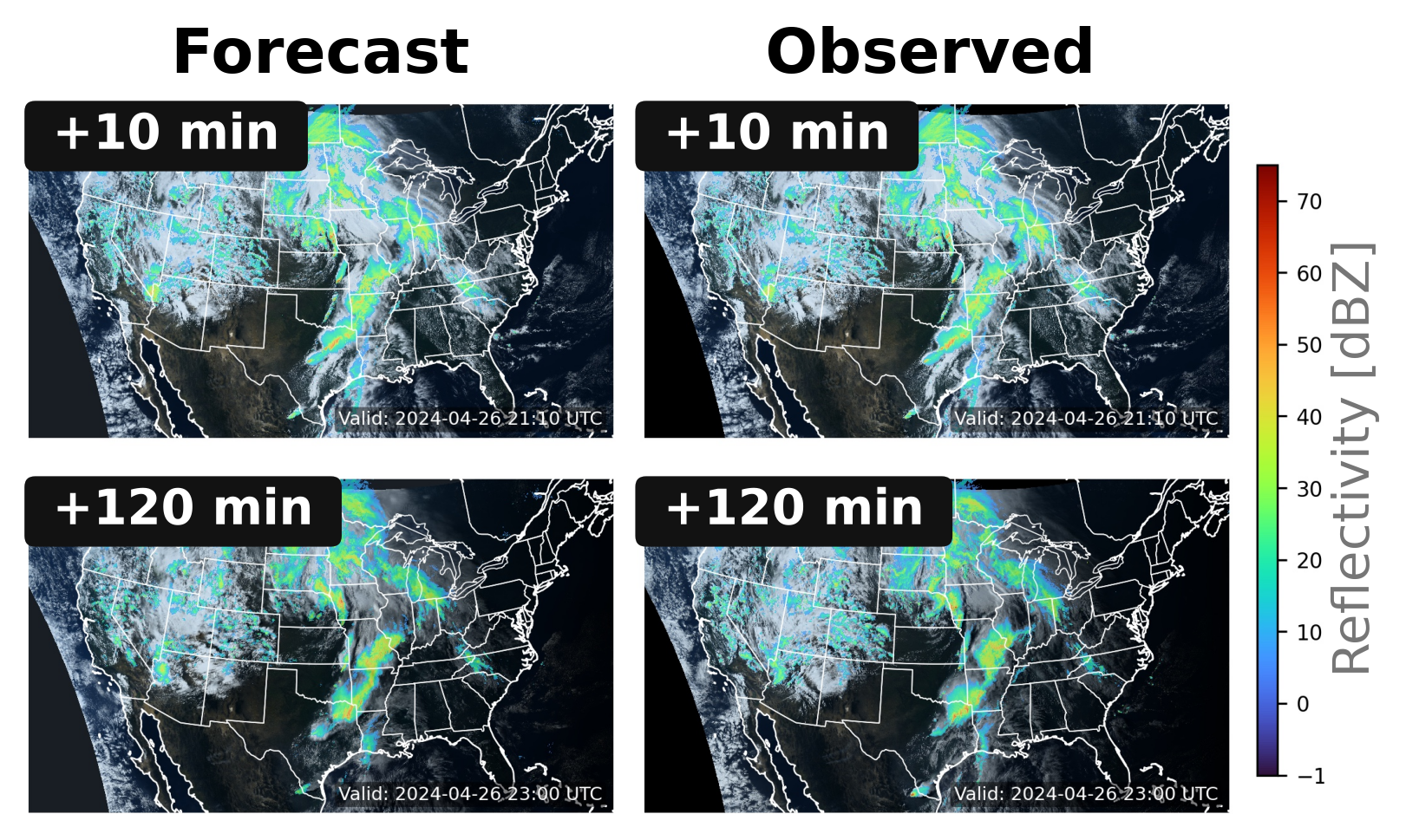
- Storms are kilometer-scale cells driven by weather systems thousands of km across. A forecast needs both.
- 1024 × 1792 grid at 3 km; satellite + radar; 2-hour diffusion forecast; 195 M parameters.
- Peak memory ≈ 114 GB > 80 GB on one H100.
- Trained on 32 H100s: 16 data-parallel groups × 2 GPUs per sample.
Left: forecast. Right: what happened. Without domain parallelism: a coarser grid or a smaller region.
Atomistic simulation: more atoms, same potential
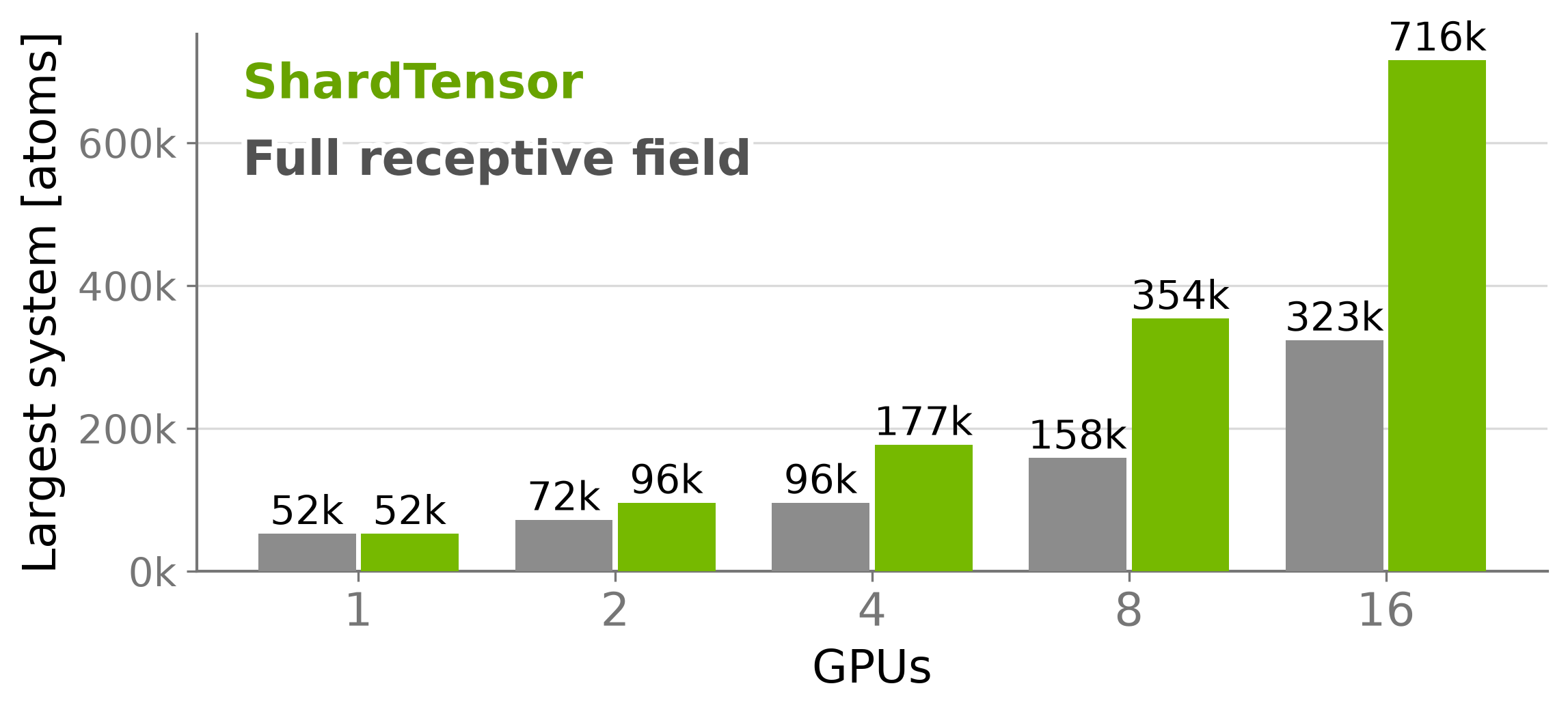
MACE on quartz (SiO₂) via NVIDIA ALCHEMI: 52 k atoms on 1 GPU → 716 k on 16 (vs. 323 k when copying the full multi-hop receptive field).
Aerodynamics: same accuracy at 8× the points
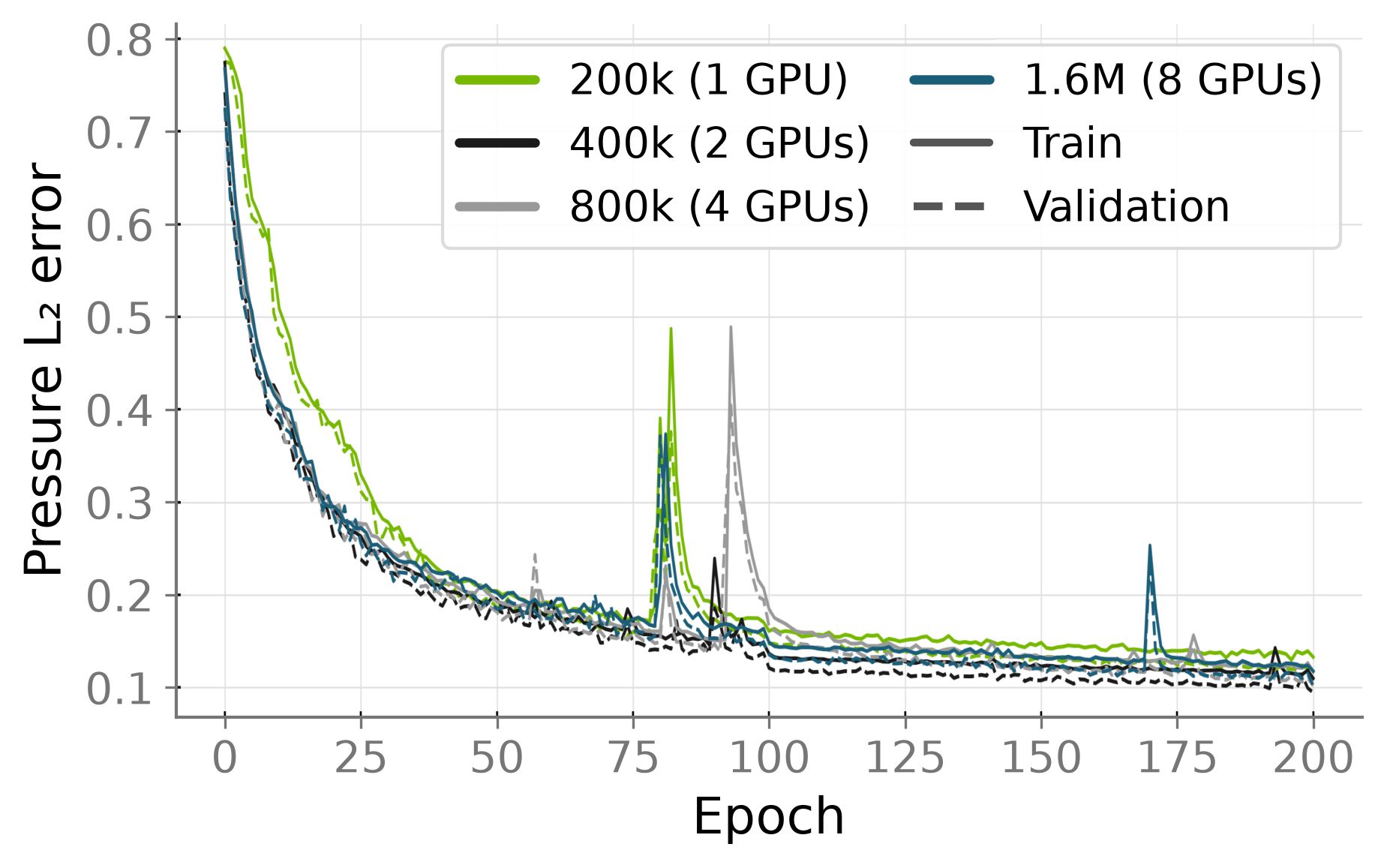
- Transolver on DrivAerML car aerodynamics, volume fields.
- 200 k points per GPU; 1, 2, 4, 8 GPUs per sample → up to 1.6 M points.
- All resolutions converge to the same pressure error (L₂ ≈ 0.10–0.12).
- Data loading and preprocessing are domain parallel too.
Domain-parallel training is as stable as single-GPU training, and combines with data parallelism.
Should you use ShardTensor?
- One sample does not fit, or one sample is too slow. If the batch can still be split, data parallelism is faster.
- Big operations. Eager dispatch costs ~60 µs per op;
torch.compilecuts it to ~0.45 µs. - Pieces that stay large. When each GPU’s piece is small next to the halo it exchanges, scaling drops.
- Fast interconnect. Results here are on NVLink (GB200 NVL72, H100 nodes).
- Operator coverage. Unregistered PyTorch ops fall back to
DTensoror a handler you write. Tested to 16 GPUs per sample.
How to use ShardTensor
1. Install NVIDIA PhysicsNeMo
Coming soon: PhysicsNeMo is splitting key functionality into standalone libraries — pip install physicsnemo-domain-parallel will soon be available.
2. Install the coding-agent skill
Clone the repo and link skills/physicsnemo-shard-tensor into your agent’s skills directory (Claude Code, Codex, Cursor, OpenCode):
- Wires
DeviceMesh+scatter_tensorinto your script without touching yournn.Module - Configures DDP or FSDP2 + domain parallelism, custom op handlers, and
torchrungradient tests
Conclusions
Resolution should be a scientific choice, not a GPU-memory limit.
- For scientific data, memory is dominated by saved inputs, which grow with the points in one sample. Sharding weights or batches does not touch them.
- Domain parallelism splits exactly that dimension. Point-wise layers need no communication; the rest need halos, all-reduces, or rings.
- ShardTensor makes it a two-line change for unmodified PyTorch models, and it already trains a 3 km storm model, larger atomistic systems, and million-point CFD surrogates.
Docs & tutorials: docs.nvidia.com/physicsnemo/latest · Source & examples: github.com/NVIDIA/physicsnemo (physicsnemo/domain_parallel)
Thank you
Questions?
Slides: coreyadams.net/talks/sc26-shardtensor (PDF) · Code: github.com/NVIDIA/physicsnemo
ShardTensor · AI4S @ SC26 · github.com/NVIDIA/physicsnemo · Slides: coreyadams.net/talks/sc26-shardtensor (PDF)